Coverstitch Skipping or Breaking at Thick Seams - How to Fix It
Skipped stitches or thread breaking specifically when sewing over thick seams is one of the most common coverstitch frustrations. It happens because the presser foot tilts as it hits the raised section, disrupting stitch formation. Here's how to deal with it.
Work through these steps in order
Start at step 1 and work your way down - most thick seam problems are solved with the right technique rather than machine settings.
Use a hump jumper
A hump jumper is a small wedge-shaped tool that sits behind the presser foot to keep it level as it approaches and leaves a thick seam. It's the most effective solution for this problem and well worth having if you regularly coverstitch over bulky areas.
- Place the hump jumper directly behind the presser foot just before the thick section begins
- It raises the back of the presser foot to match the height of the seam, keeping it level throughout
- Remove it once the presser foot is past the raised area
- If you don't have a hump jumper, a folded piece of scrap fabric of the same height works as a quick alternative
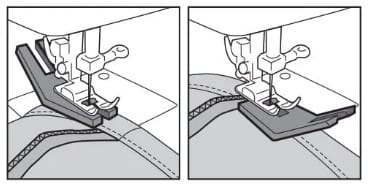
A hump jumper placed behind the presser foot levels it out as it approaches a thick seam, preventing tilting and keeping stitches forming correctly.
Clip the seam allowances at the fold
Reducing the bulk at the seam before you get to it makes it much easier for the machine to stitch over cleanly.
- Before coverstitching, clip the seam allowances at the fold of the hem
- Press them in opposite directions so they fan out rather than all sitting on one side
- This reduces the bulk at the seam significantly and is one of the simplest and most effective fixes
Adjust your speed at the thick section
Speed can make a real difference when sewing over bumps - it's worth experimenting on scrap to find what works best on your machine.
- Try slowing right down as you approach the thick section - this gives the needle more time to form each stitch through the extra layers
- Some sewists find going faster over thick seams actually works better - the machine carries its momentum through the bulk
- Test both approaches on scrap fabric first to see which gives better results on your machine
Approach the seam at an angle
Rather than hitting the thick section straight on, approaching it at a slight angle means the presser foot encounters the raised section gradually rather than all at once.
- Steer the fabric very slightly so the presser foot hits one side of the seam before the other
- This gradual approach can significantly reduce skipping and thread stress at the thick point
Check and replace the needle
A fresh needle handles thick seams and multiple layers much better than a blunt one.
- Replace the needle before tackling thick fabrics or multiple layers if it's been in the machine a while
- Make sure you're using the correct needle type - ELx705 is recommended for most coverstitch machines
- Consider going up a needle size for very thick fabrics - a heavier needle pushes through the layers more cleanly
Test on scrap fabric
Before sewing your actual project, test on scrap with the same number of layers and the same seam bulk. This lets you work out the best approach - speed, angle and hump jumper positioning - without risking your actual piece.
Quick fix checklist
Run through this before contacting us - it covers the most common causes.
- Hump jumper or folded scrap fabric used to level the presser foot over the thick section
- Seam allowances clipped at the fold and pressed in opposite directions to reduce bulk
- Speed adjusted at the thick section - test both slower and faster on scrap
- Thick section approached at a slight angle rather than straight on
- Fresh ELx705 needle fitted, correct size for fabric weight
Still having trouble? We're here to help.
If you're still having problems at thick seams after working through these steps, get in touch and our team will take it from there.
Was this article helpful?
Thanks for your feedback!
Sorry this article didn't help. Tell us what's missing and we'll improve it.